
Botox vs. Dermal Filler: Which One Actually Fixes Your Concern?

A lot of patients book a consultation asking for "a little Botox" when what bothers them is a hollow under the eyes, or ask for filler when the line they hate only shows up when they frown. It's an easy mix-up. Both are injectables, both take about 20 minutes, and both are marketed side by side. But Botox and dermal filler do completely different things, and choosing the wrong one means paying for a treatment that can't fix the problem you came in with.
Here is how to tell which one your concern calls for, and when it makes sense to use both.
The Short Answer: Movement vs. Volume
If a line appears or deepens when you make an expression, it is usually a movement problem, and Botox is the tool for it. If an area looks hollow, flat, or deflated even when your face is at rest, it is usually a volume problem, and filler is the tool for it.
Botox (and similar neuromodulators such as Dysport, Xeomin, and Daxxify) temporarily relaxes the specific muscles that crease the skin.
Dermal filler, most often a hyaluronic acid gel, adds volume and structure under the skin to replace what age has taken away.
That single question, "does it change when I move?", sorts most concerns before you ever sit in the treatment chair.
Botox and Filler Do Two Different Jobs
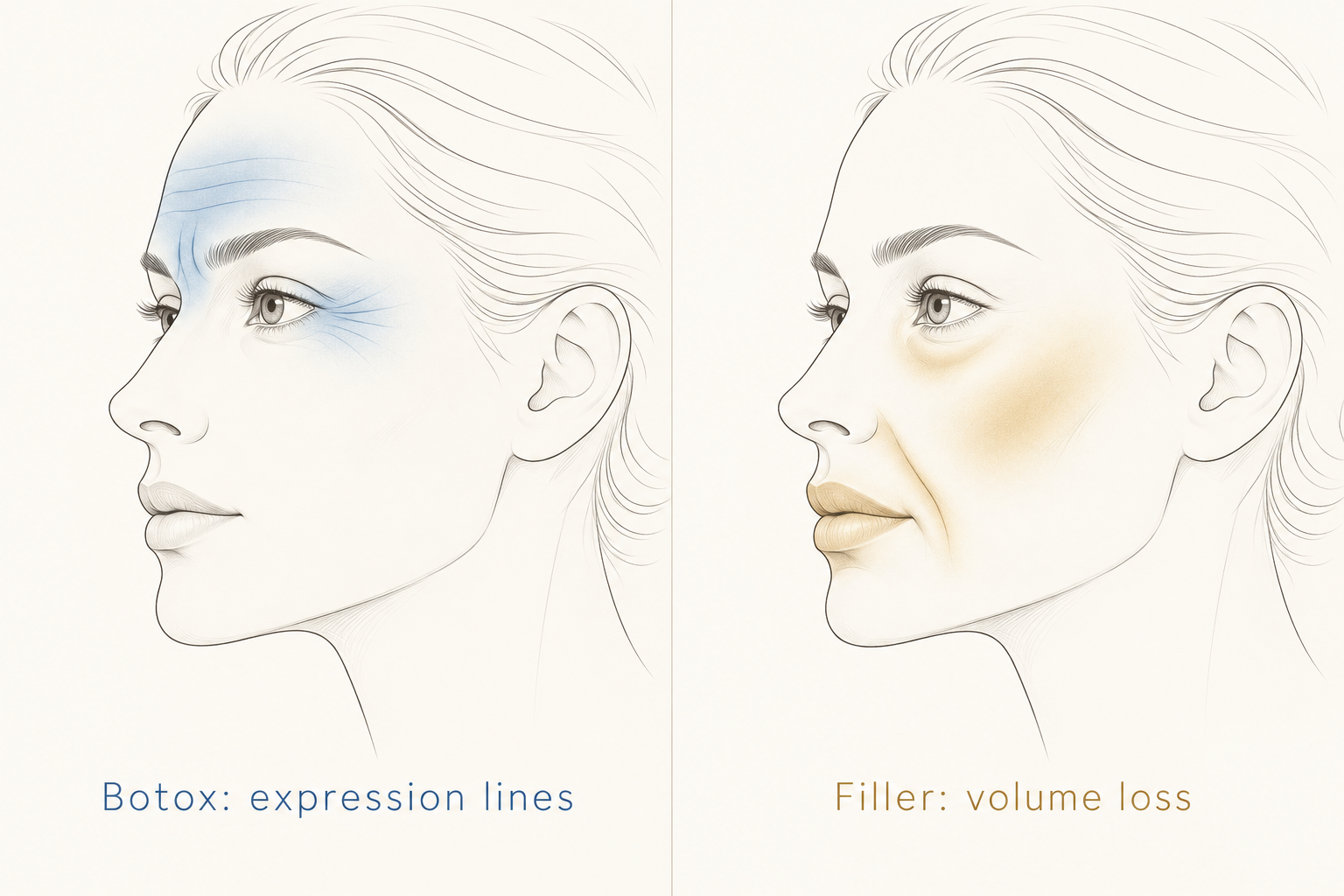
What Botox treats
Botox works on dynamic wrinkles, the lines created by repeated muscle movement. It is best known for:
Forehead lines
The "11s" between the eyebrows (glabellar lines)
Crow's feet at the outer corners of the eyes
A subtle brow lift at the tail of the brow
A "lip flip" to show slightly more of the upper lip
Vertical neck bands (platysma bands)
Jaw slimming and clenching relief (masseter treatment)
Results begin to show in 3 to 5 days, settle fully around two weeks, and typically last 3 to 4 months. For more on when to start and how dosing changes over time, see Botox in Your 20s, 30s, and 40s.
What filler treats
Filler works on static concerns, the things you can see even with a completely relaxed face:
Thinning lips or loss of lip shape
Flattened cheeks and midface volume loss
Under-eye hollows (tear troughs)
Deep smile lines (nasolabial folds) and marionette lines
A soft or poorly defined jawline and chin
Filler results are visible right away, with the final look settling over one to two weeks as swelling resolves. Depending on the product and area, results last roughly 6 to 18 months. Lips tend to be on the shorter end because they move constantly, while cheeks and jawline hold longer. Our guide to lip, cheek, and jawline filler breaks down each area in more detail.
Botox or Filler for Wrinkles? It Depends on the Wrinkle
"Wrinkles" is where most of the confusion happens, because some lines are part movement and part volume.
Forehead lines that only appear when you raise your brows: Botox.
Forehead lines that stay etched in at rest: Botox to stop them deepening, sometimes with skin treatments such as Morpheus8 or SkinPen to improve the crease itself.
Crow's feet: Botox in most cases.
Smile lines from nose to mouth: Usually filler, often placed in the cheek rather than directly in the fold, because the fold is frequently caused by midface volume loss above it.
Lines around the lips: Often a combination of a small amount of Botox and a soft, thin filler.
Marionette lines at the corners of the mouth: Usually filler, sometimes with Botox to relax the muscle that pulls the corners downward.
This is why an in-person evaluation matters. Two people can point to the same line and need different treatments.
Side-by-Side Comparison
What it does: Botox relaxes muscles. Filler adds volume.
Best for: Botox for expression lines. Filler for hollows, lost volume, and contour.
When results appear: Botox in 3 to 14 days. Filler immediately, refined by about two weeks.
How long it lasts: Botox about 3 to 4 months. Filler about 6 to 18 months depending on area and product.
Reversible? Botox wears off on its own. Hyaluronic acid filler can be dissolved with an enzyme called hyaluronidase if needed.
Downtime: Minimal for both. Filler can cause more swelling and bruising, especially in the lips.
When Botox and Filler Work Better Together

Many of the most natural results come from using both in small amounts rather than a lot of either one. Aging involves both muscle activity and volume loss, so treating only one side of the problem can leave the result looking incomplete.
A common example is the lower face. Filler can restore support along the cheeks and jawline, while a small amount of Botox relaxes the muscles that pull the corners of the mouth down. Neither treatment alone gives the same softened, rested look.
The goal is not to use more product. It is to use the right product in the right place, which is also the core of our approach described in Why Good Filler Is Invisible.
Why Who Injects You Matters as Much as What You Get
Botox and filler are both medical treatments. Understanding facial anatomy, blood vessel location, and how the face changes with age is what separates a refreshed result from an overdone one, and it is also what keeps treatment safe. Filler in particular carries a small but real risk of vascular complications that must be recognized and treated immediately.
Dr. Derderian is a board-certified plastic surgeon with craniofacial fellowship training and more than a decade on the plastic surgery faculty at UT Southwestern. That surgical understanding of facial structure shapes every injectable plan at our Dallas practice.
Frequently Asked Questions
-
Botox relaxes the muscles that cause expression lines, while filler adds volume to areas that have become hollow or flat. Botox treats movement; filler treats volume.
-
Botox is usually better for wrinkles caused by expression, such as forehead lines, frown lines, and crow's feet. Filler is usually better for folds and creases caused by volume loss, such as deep smile lines and marionette lines.
-
Filler generally lasts longer. Botox typically lasts 3 to 4 months, while filler lasts about 6 to 18 months depending on the area treated and the product used.
-
Yes. Many patients receive both in one visit. Your injector will plan the order and placement so the two treatments complement each other.
-
Both are very safe in experienced, medically trained hands. Each has different risks: Botox can occasionally cause temporary heaviness or a drooping brow or eyelid, while filler carries a rare risk of blocking a blood vessel. Choosing a qualified, physician-led practice is the best way to reduce either risk.
-
Botox is usually priced per unit and filler per syringe, so the total depends on how many areas you treat. We cover Botox pricing in detail in our Dallas Botox cost guide, and your consultation will include an exact quote.
Dr. Derderian is a renowned plastic surgery specialist in Dallas, TX. We invite you to book a consultation to find out whether Botox, filler, or a combination is right for your concern.