
Lip Filler, Cheek Filler, Jawline Filler: What's the Difference and Where Should You Start?
Most consultations start the same way: a patient points to their lips and says, "I think I want filler here." Ten minutes into the conversation, it's often clear the lips aren't actually the problem -- the midface has lost volume, or the jawline has softened, and the lips just happen to be the most visible symptom. Lip, cheek, and jawline filler treat three different structural issues, and picking the right one first changes how natural -- and how efficient -- your results end up being.
Filler Isn't One Treatment -- It's Three Different Jobs
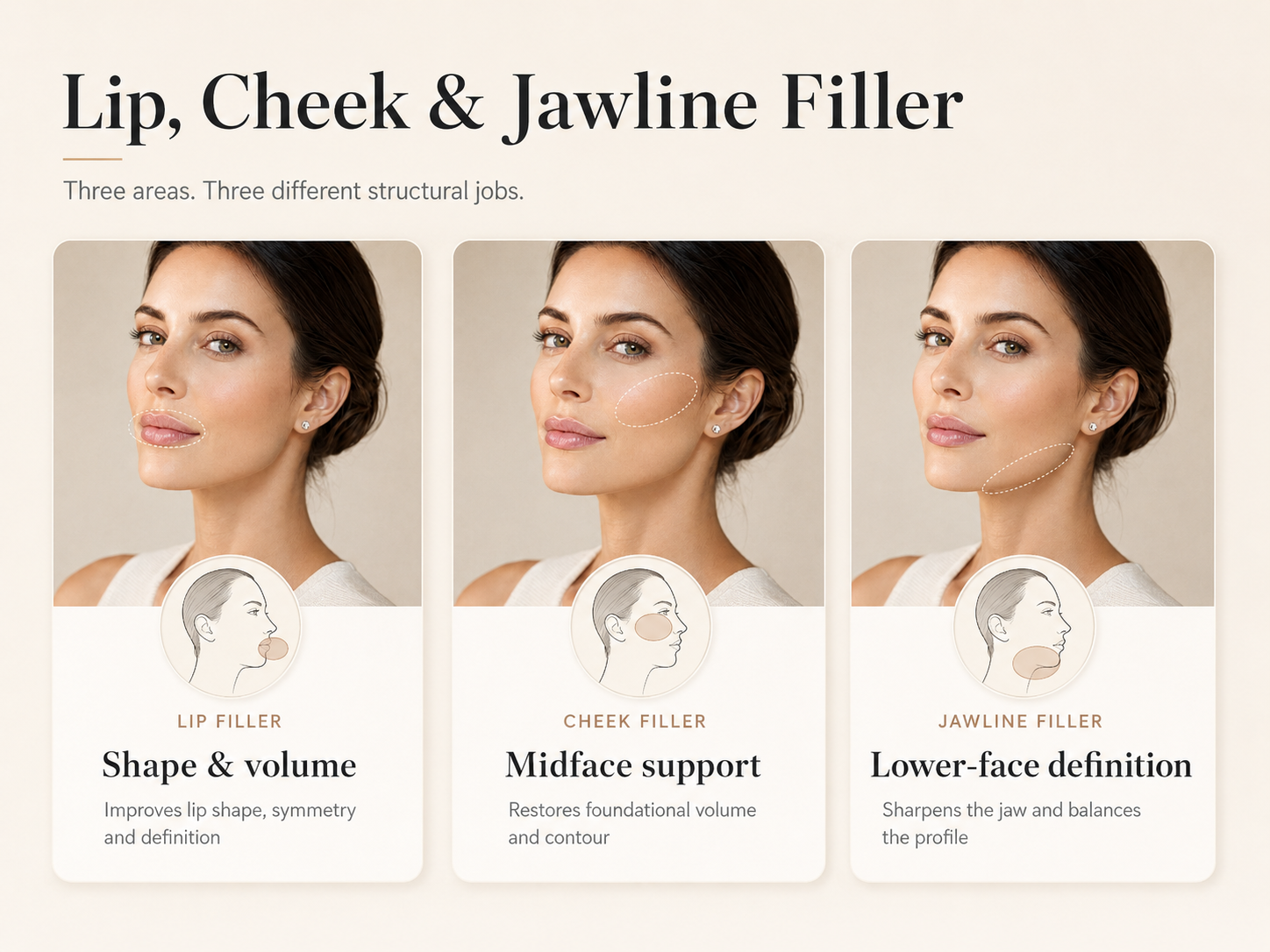
It's easy to think of "filler" as a single category, since the product itself (usually a hyaluronic acid gel) is often similar across areas. But where that gel goes, and what job it's doing once it's there, is completely different depending on the area.
Lip filler adds volume and shape to a soft, highly mobile structure.
Cheek filler rebuilds structural support in the midface, where bone and fat naturally recede with age.
Jawline filler sculpts and defines the border of the lower face, often creating angles that were never there to begin with, or restoring ones that softened over time.
Because each area is solving a different problem, "more filler" in the wrong place doesn't fix the concern that's actually bothering you. That's the mistake this article is meant to help you avoid.
Lip Filler: What It Actually Treats
Lip filler is the most requested of the three, and it's usually the most straightforward. It's designed to address:
Age-related volume loss in the lips
Asymmetry between the upper and lower lip
A flattened or poorly defined cupid's bow
Vertical lip lines (sometimes called "smoker's lines," even in people who've never smoked)
General thinning that happens gradually after your mid-20s
Lip filler is also one of the few filler treatments where you can see the result immediately, since the change is localized and visible without needing to wait on surrounding tissue to settle. That immediacy is part of why it's the entry point for a lot of patients -- but it's not always the area with the biggest structural need. For more on how to keep lip results looking like your lips instead of "done," see [Why Good Filler Is Invisible (and Bad Filler Is Everywhere)].
Cheek Filler: Rebuilding the Foundation of Your Midface
Cheek volume loss is one of the more underappreciated parts of facial aging. As the fat pads and bone in the midface shrink, the face doesn't just look flatter -- it loses the support structure that holds up everything below it, including the nasolabial folds and jowls.
Cheek filler is typically used to:
Restore volume lost to natural aging
Improve the appearance of nasolabial folds without treating them directly
Create a lifted, more contoured look through the midface
Balance a face that looks tired or hollow, even at rest
Provide structural support that indirectly softens lower-face sagging
Because the cheeks affect so much of the surrounding anatomy, patients are often surprised by how much a conservative amount of cheek filler changes the lower two-thirds of the face -- without ever touching the jawline or mouth.
Jawline Filler: Definition, Angles, and Lower Face Balance
Jawline filler is the newest of the three to become mainstream, and it's grown fastest in the last few years alongside the broader trend toward non-surgical facial contouring. It's used to:
Add definition along the mandible for a sharper profile
Soften early jowls without surgery
Improve the chin-to-jaw relationship, especially in profile
Create a stronger, more balanced lower face for patients with a naturally softer jawline
Support skin that has started to loosen slightly along the jaw
Jawline filler tends to use firmer, more structural filler products than lips, since it needs to hold up against the movement and pressure of chewing, talking, and expression all day.
How Long Each Type of Filler Lasts (and Why That Matters for Where You Start)
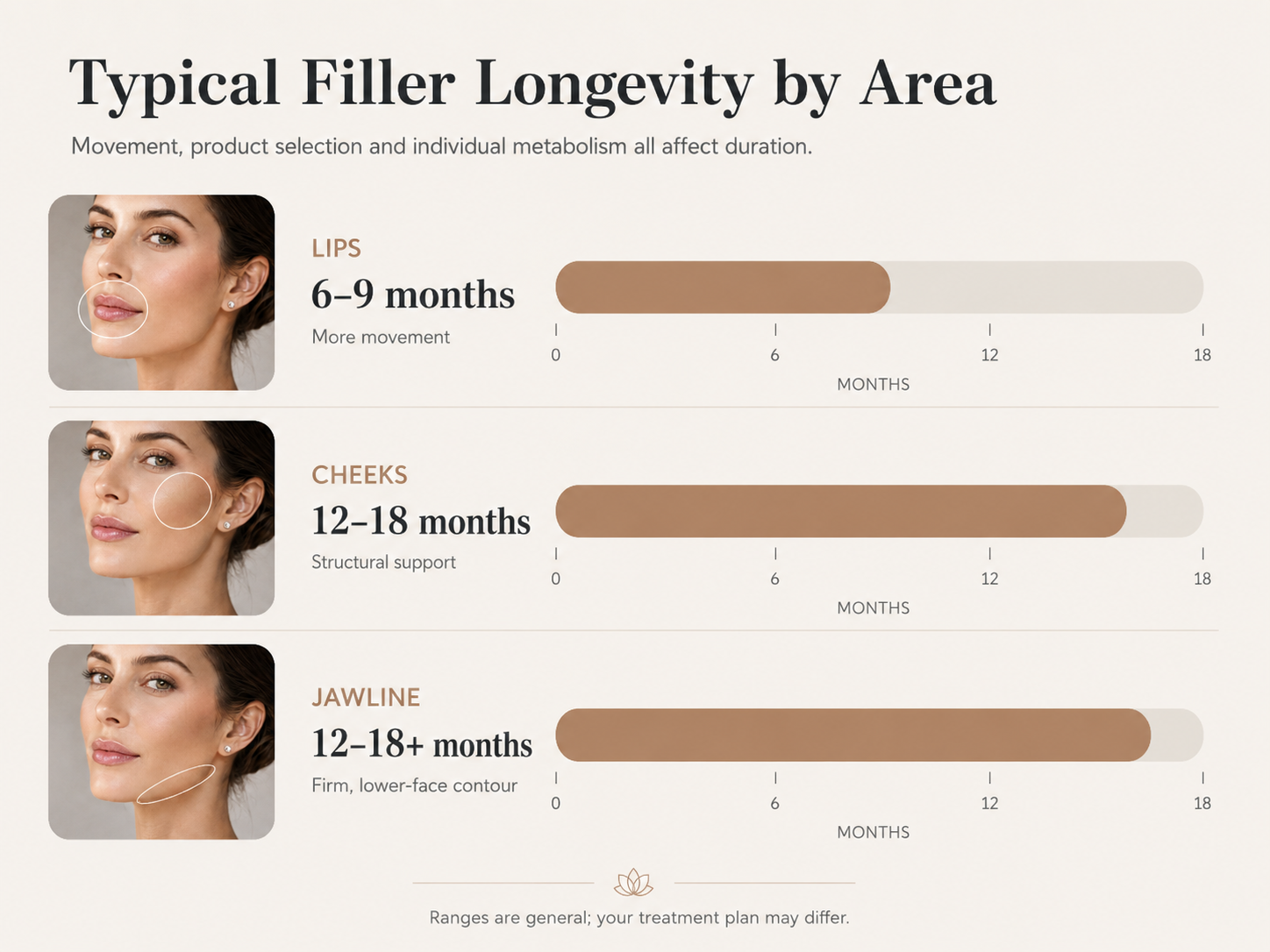
Longevity varies significantly by area, mostly because of how much the tissue moves. Lips move constantly -- talking, eating, smiling -- so filler there tends to break down faster, often in the 6-to-9-month range. Cheeks and jawline see less mechanical movement and tend to hold filler longer, frequently 12 to 18 months or more depending on the product used.
This matters for planning, not just aesthetics. If you're working with a maintenance budget, starting with the area that lasts longer gives you more mileage before your first touch-up. If your primary concern is something that changes quickly with expression -- like lip shape -- that's a reasonable place to start regardless of longevity, since it's the area actually bothering you.
So Where Should You Actually Start?
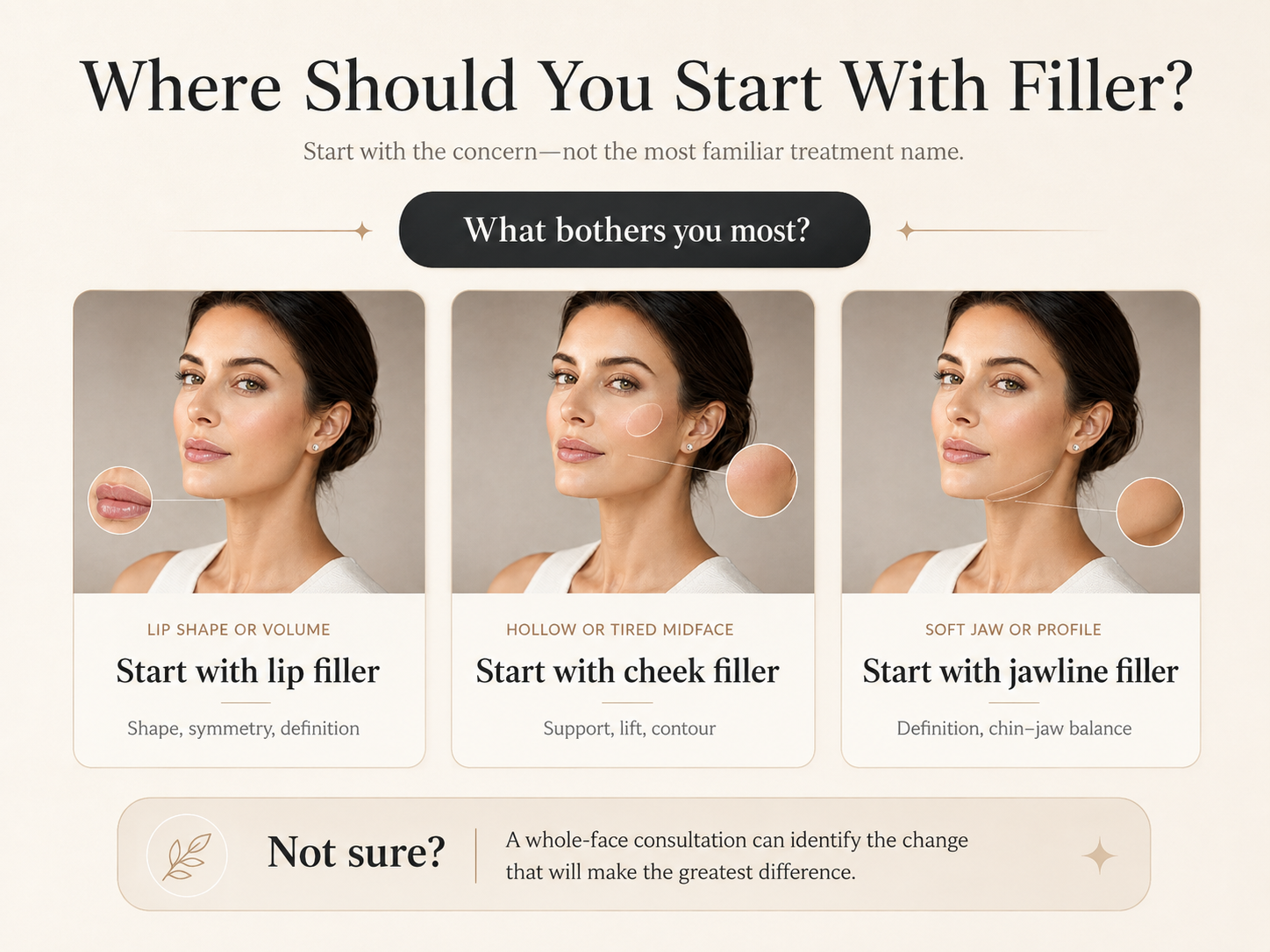
There's no universal answer, but a few patterns show up consistently in consultation:
If your main concern is structural -- a face that looks tired, hollow, or like it's "lost something" -- cheeks are usually the more efficient starting point, since they support everything below them.
If your concern is specifically about definition or a soft jawline in profile, jawline filler addresses that directly and won't be solved by cheek or lip filler alone.
If your concern is genuinely about your lips -- shape, symmetry, volume -- start there. Not every treatment plan needs to start with the "foundational" area first.
If you're not sure, a consultation that evaluates your whole face (not just the area you walked in asking about) is the fastest way to figure out which change will actually move the needle.
Combining Areas for Facial Harmony
Many patients eventually use filler in more than one of these areas, but rarely all at once as a first treatment. The more common path is starting with the area causing the most noticeable concern, seeing how the face responds, and adding a second area later if needed. Treating the face as a connected system -- rather than a list of isolated features -- is also what keeps results looking proportionate instead of like separate treatments layered on top of each other.
Frequently Asked Questions
-
Description text goes hereLip filler adds volume and shape to the lips themselves, while cheek filler restores structural volume in the midface that supports the rest of the lower face. They address different concerns and are rarely interchangeable.
-
It depends on where your concern actually is. Cheek filler is typically the better starting point for a face that looks hollow or tired overall, while jawline filler is more direct if your main concern is definition along the jaw and chin in profile.
-
Description text goes hereJawline filler generally lasts longer -- often 12 to 18 months or more -- because the area sees less mechanical movement than the lips, which typically need touch-ups every 6 to 9 months.
-
Yes, though most patients start with one or two areas and add more over time as they see how their face responds. A consultation can help determine whether combining areas makes sense for your goals and budget.
-
No. While jawline filler is popular among men seeking a stronger, more angular profile, it's just as commonly used by women looking to soften early jowls, improve chin-jaw balance, or add subtle definition.
-
Often, yes. Younger patients frequently start with lips for shape and volume, while patients in their late 30s and beyond are more likely to start with cheeks or jawline, where structural volume loss becomes more noticeable.
Dr. Derderian is a renowned plastic surgery specialist in Dallas, TX. We invite you to book a consultation to determine which filler treatment -- or combination -- fits your face and your goals.