People often come in because others keep asking whether they're tired. They sleep well, they've tried eye creams, and some have had filler or a skin treatment under the eyes. The eyes still look heavy. When the cause is extra eyelid skin or fat pushing forward beneath the eyes, no cream, injection, or energy device will remove it. Eyelid surgery, called blepharoplasty, is the procedure designed to correct it directly.
What Causes Hooded Eyes and Under-Eye Bags?
The skin of the eyelids is the thinnest on the body, and it's one of the first places aging shows. Two separate changes cause most concerns:
• Excess upper eyelid skin stretches and folds over the natural crease, creating a hooded look. It can make eye makeup difficult and, in more advanced cases, can block part of your upper field of vision.
• Under-eye fat bulges form when the thin membrane that holds fat around the eye weakens, allowing fat to push forward into visible bags. Genetics play a big role, which is why some people have bags in their 20s and 30s.
A third cause is sometimes mistaken for eyelid hooding: a descended brow. When the brow sits lower than it used to, it pushes skin down onto the lid. In that case a brow lift, alone or with eyelid surgery, may be the better fix. Sorting out which cause is responsible is one of the most important parts of your consultation.
Upper vs. Lower Blepharoplasty
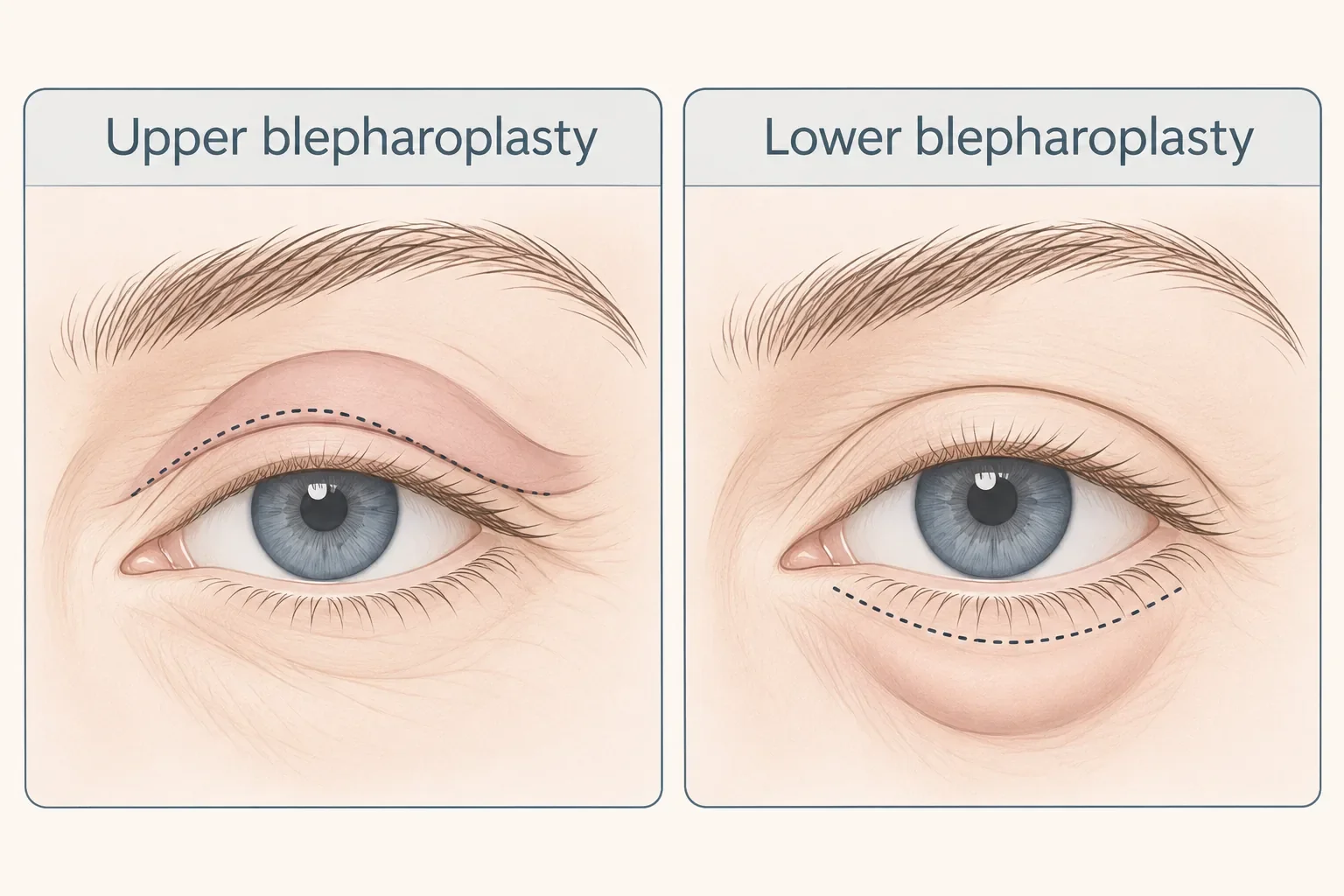
Upper blepharoplasty
Upper eyelid surgery removes excess skin and, when needed, a small amount of fat through an incision hidden in the natural eyelid crease. Once healed, the scar is typically very difficult to see. The result is a more open, defined lid that looks rested rather than surgically changed.
Lower blepharoplasty
Lower eyelid surgery addresses under-eye bags. Depending on your anatomy, the fat may be removed or repositioned to smooth the transition between the lower lid and the cheek. It can be performed through an incision just below the lashes or through the inside of the lower lid, which leaves no visible scar. Repositioning fat, rather than only removing it, helps avoid the hollow look that can come with older techniques.
Many patients have upper and lower eyelid surgery together, and eyelid surgery is often combined with a brow lift or facelift.
Why Filler and Morpheus8 Can't Fix Everything Around the Eyes
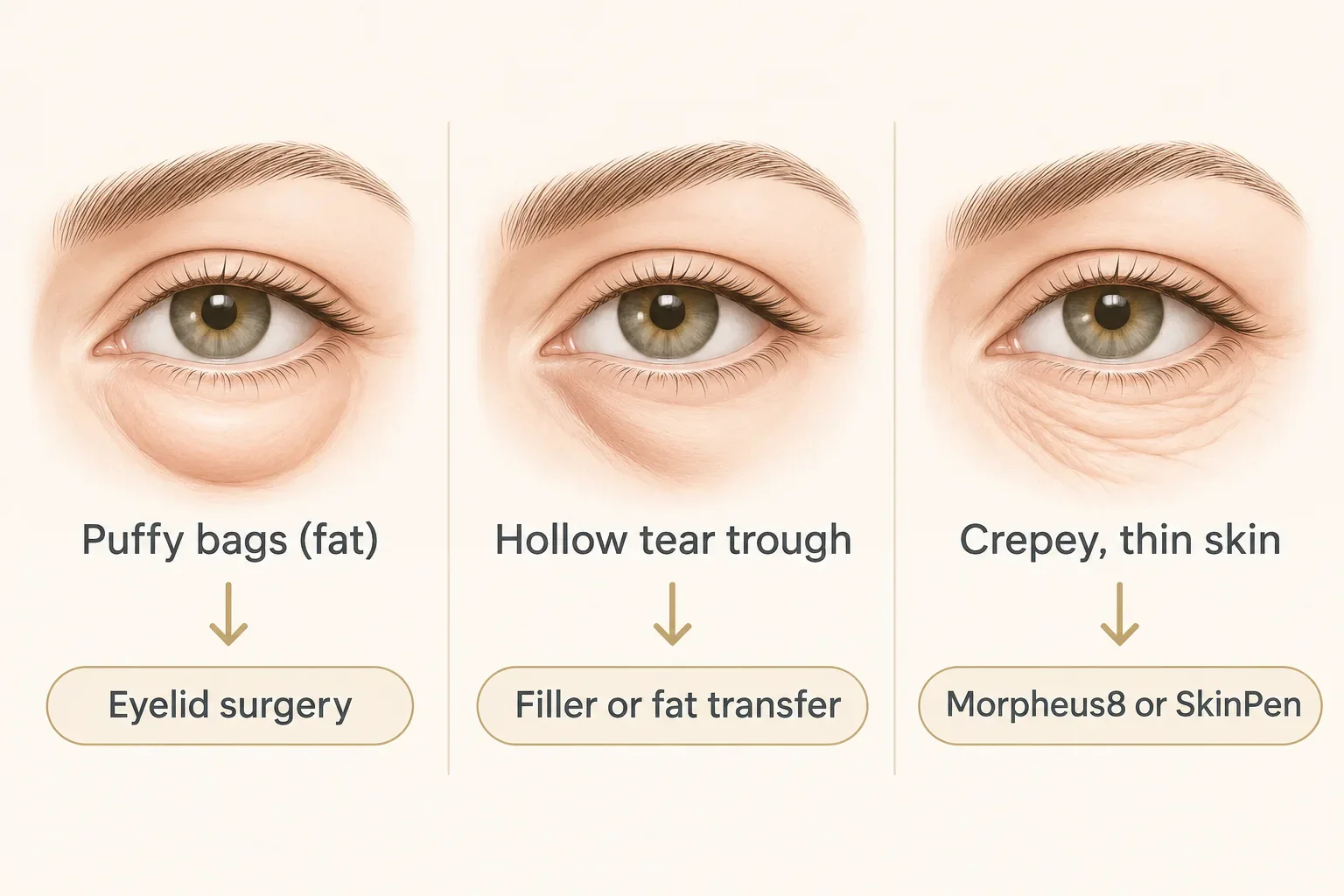
Non-surgical treatments work well for the right concern:
• Under-eye filler can soften a hollow tear trough. It can make bags look worse if the problem is protruding fat, because it adds more volume to an area that already has too much.
• Morpheus8 and SkinPen improve crepey texture and fine lines in the skin itself. They don't remove fat or significant excess skin. We cover what Morpheus8 can do for the under-eye area in Why Everyone's Talking About Morpheus8 for Jawlines and Under-Eyes.
• Botox softens crow's feet but has no effect on hooding or bags.
A simple test: if gently lifting the brow or pressing lightly on the cheek makes the problem disappear, the issue is likely skin, fat, or position, and surgery tends to give a better and longer-lasting result.
Who Is a Good Candidate for Eyelid Surgery?
• Adults with excess upper eyelid skin or persistent under-eye bags
• People whose hooded lids interfere with vision or makeup
• Patients who have tried non-surgical treatments without the result they wanted
• Non-smokers in good general health without untreated dry eye or significant eye conditions
Eyelid Surgery Recovery
• First few days: Swelling and bruising are most noticeable. Cold compresses and head elevation help. Discomfort is usually mild.
• About one week: Sutures, if used, are removed. Many patients feel comfortable in public with sunglasses.
• 10 to 14 days: Most return to work and social activities. Makeup can usually be worn by this point.
• Several weeks to months: Remaining swelling resolves and the incision continues to fade.
Results of upper eyelid surgery are long lasting. Lower eyelid surgery results are often considered permanent, since the fat that was removed or repositioned doesn't return in the same way.
How Much Does Eyelid Surgery Cost in Dallas?
The American Society of Plastic Surgeons reported an average national surgeon's fee of roughly $3,000 to $5,500 for upper eyelid surgery and about $3,700 to $6,500 for lower eyelid surgery in 2024. Anesthesia and facility fees are additional, and having both upper and lower surgery together changes the total.
When excess upper eyelid skin is blocking vision, upper blepharoplasty may be considered medically necessary and partially covered by insurance, usually after a visual field test. Cosmetic eyelid surgery is not covered.
Why Choose a Plastic Surgeon With Facial Expertise
The eyelids are small, delicate structures that affect both appearance and eye function. Removing too much skin or fat can cause dry eye, difficulty closing the eyes, or a hollow look. Dr. Derderian is board certified by the American Board of Plastic Surgery with craniofacial fellowship training, and his approach is conservative: open and refresh the eyes while keeping them looking like yours.
Frequently Asked Questions
-
Upper blepharoplasty removes excess skin (and sometimes fat) from the upper eyelid to correct hooding. Lower blepharoplasty removes or repositions under-eye fat to reduce bags and smooth the lid-cheek transition.
-
Mild hooding caused by a low brow can sometimes be improved with Botox to lift the tail of the brow. Excess eyelid skin itself can only be removed surgically.
-
Upper eyelid incisions are hidden in the natural crease and are usually very hard to see once healed. Lower eyelid surgery can often be done from inside the lid, leaving no visible scar.
-
Most patients return to work and social activities in about 10 to 14 days. Swelling continues to improve over the following weeks.
-
Upper eyelid surgery may be covered when excess skin blocks your vision, usually documented with a visual field test. Cosmetic eyelid surgery, including most lower eyelid surgery, is not covered.
-
If the bags are caused by protruding fat, eyelid surgery is usually the better option. Filler works best for hollowness, not puffiness.